Poisson CPP






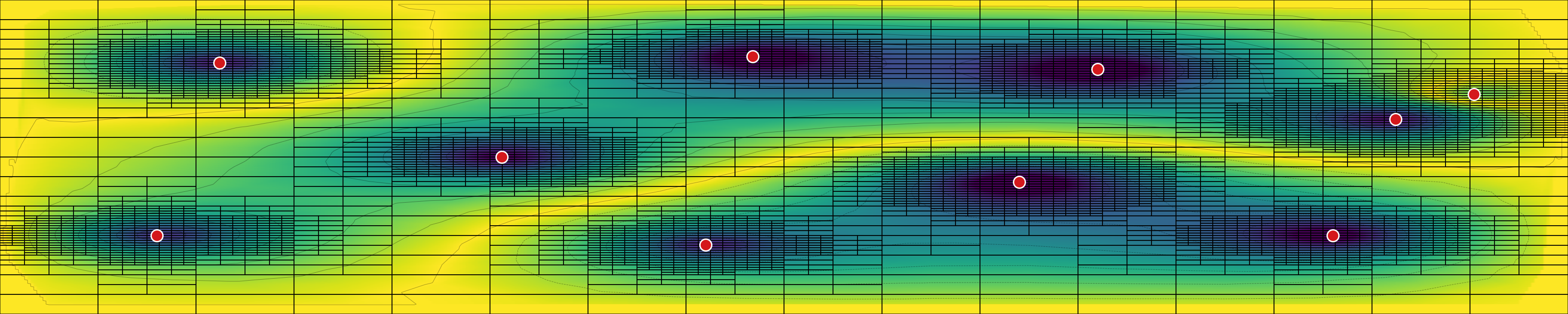
python/make_banner.py. Solveurs
| Module | Algorithme | Coût | BC supportées |
|---|---|---|---|
linalg::thomas | Tridiagonal direct | O(N) | toutes |
fv::Solver1D | FV + Thomas | O(N) | Dirichlet (ε uniforme ou variable) |
fv::Solver2D | FV + SOR red-black ω_opt | O(N³) | Dirichlet×Neumann |
iter::solve_poisson_cg | CG / PCG Jacobi | O(N³), ~5× SOR | Dirichlet×Neumann |
spectral::DSTSolver2D | DST-I via FFTW | O(N²·logN) | Dirichlet homogène |
amr::Quadtree + sor | Quadtree Morton + FV hétérogène | O(nb_leaves × iter) | Dirichlet V = 0 au bord |
mg::vcycle_amr_composite | V-cycle 2-grid composite AMR | O(nb_leaves) par cycle | Dirichlet V = 0 |
Tous matrix-free. Pseudocode de chaque solveur : **docs/ALGORITHMS.md**. Conventions de grille et schémas modules : docs/ARCHITECTURE.md.
Documentation
- Python (Sphinx) : https://wolf75222.github.io/poisson_cpp/
- C++ (Doxygen) : https://wolf75222.github.io/poisson_cpp/cpp/
Quick start
Prérequis
- C++20 (AppleClang 16+, GCC 12+, Clang 15+, MSVC 19.36+)
- CMake ≥ 3.20
- Eigen ≥ 3.4 *(fetched automatiquement si absent)*
- FFTW3 *(optionnel, active le solveur spectral)*
- OpenMP *(optionnel, parallel sweeps à partir de N ≥ 384)*
- Python 3.9+ *(optionnel, bindings pybind11)*
Build
Options CMake :
| Option | Défaut | Rôle |
|---|---|---|
POISSON_BUILD_TESTS | ON | Compile Catch2 + toute la suite |
POISSON_BUILD_BENCHMARKS | ON | Compile bench_solvers et profile_cg |
POISSON_USE_OPENMP | OFF | Parallélise SOR + gs_smooth au-delà de N ≥ 384 |
POISSON_BUILD_PYTHON | OFF | Génère le module poisson_cpp via pybind11 |
Exécuter le démo C++
Utilisation depuis Python (pybind11)
Installation pip
Le wheel est compilé localement par scikit-build-core. Prérequis : compilateur C++20 et CMake ≥ 3.20. Eigen et nlohmann_json sont récupérés automatiquement. FFTW3 est optionnel ; sans lui, DSTSolver1D/2D sont désactivés et un RuntimeWarning à l'import donne la commande d'installation pour ta plateforme.
Google Colab
Si FFTW est installé après coup, force la recompilation :
Build manuel depuis les sources
Exemple
Plots
Figures dans docs/figures/, interprétations dans `docs/RESULTS.md`.
Résultats
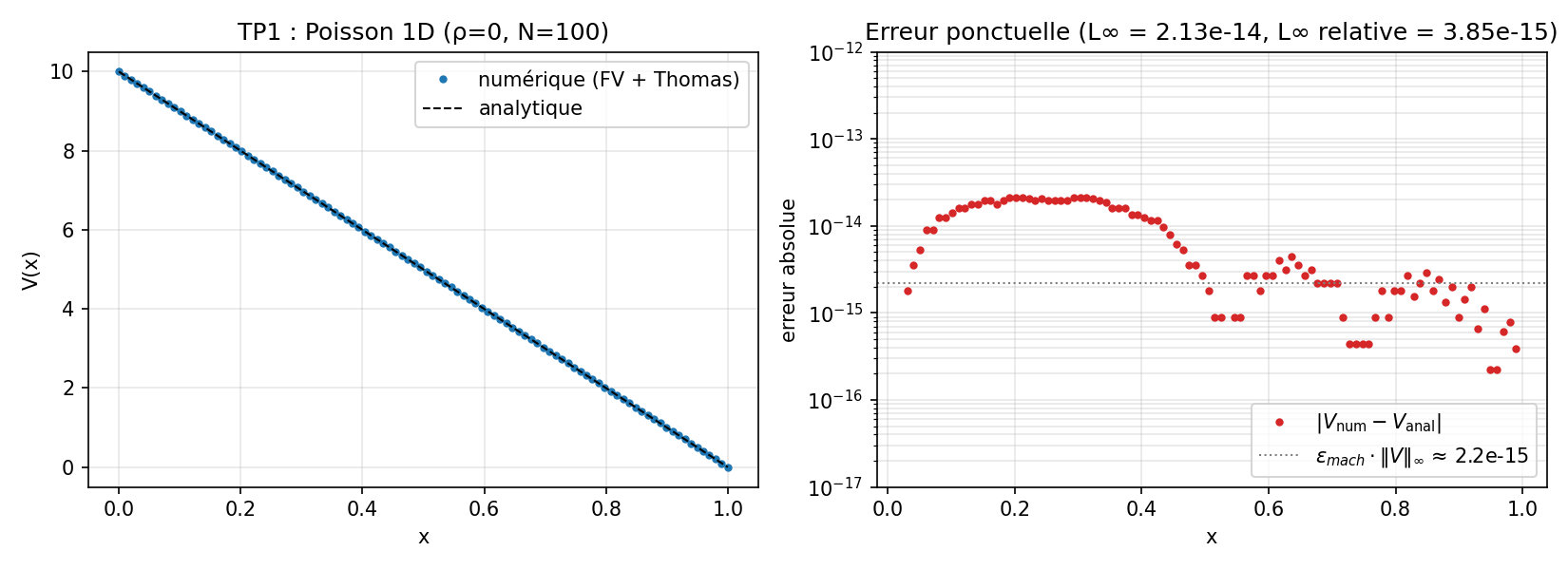 | 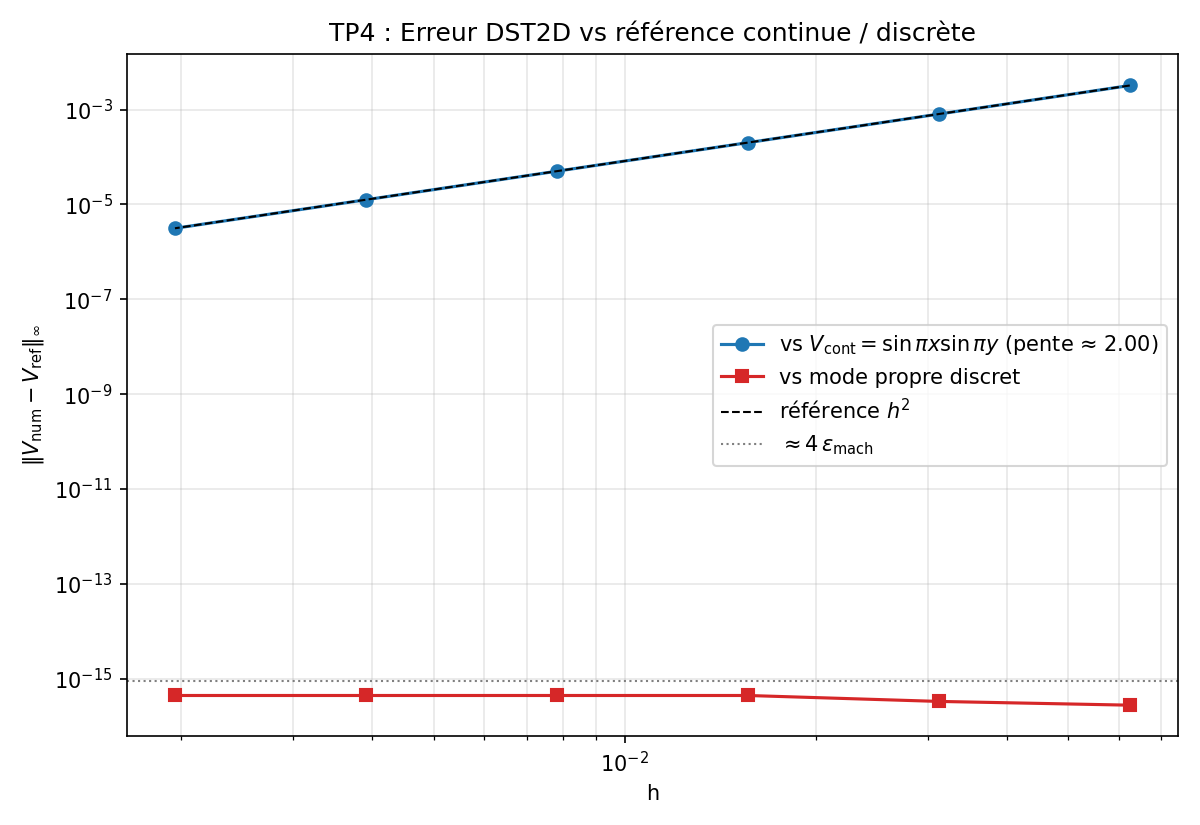 |
| Poisson 1D, erreur L∞ = 2.1×10⁻¹⁴ (précision machine) | Convergence spectrale, pente log-log = +2.000 |
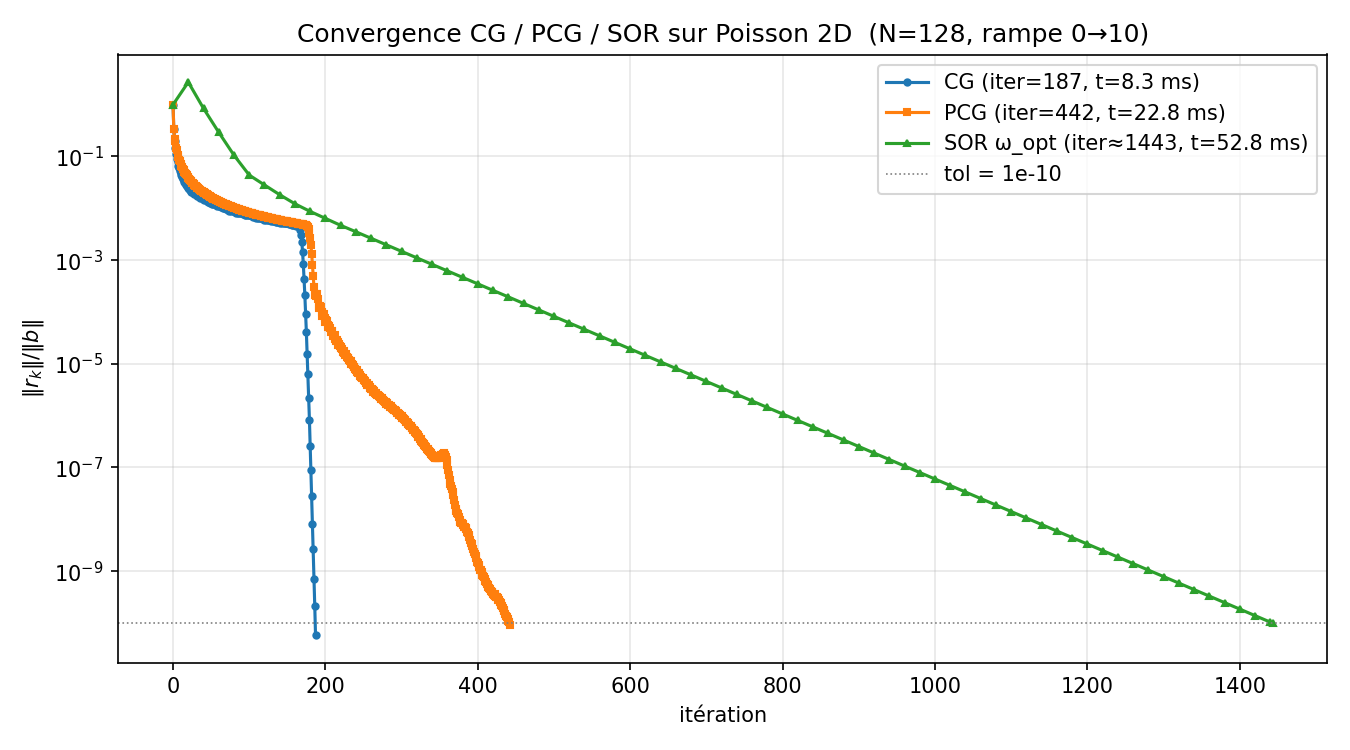 | 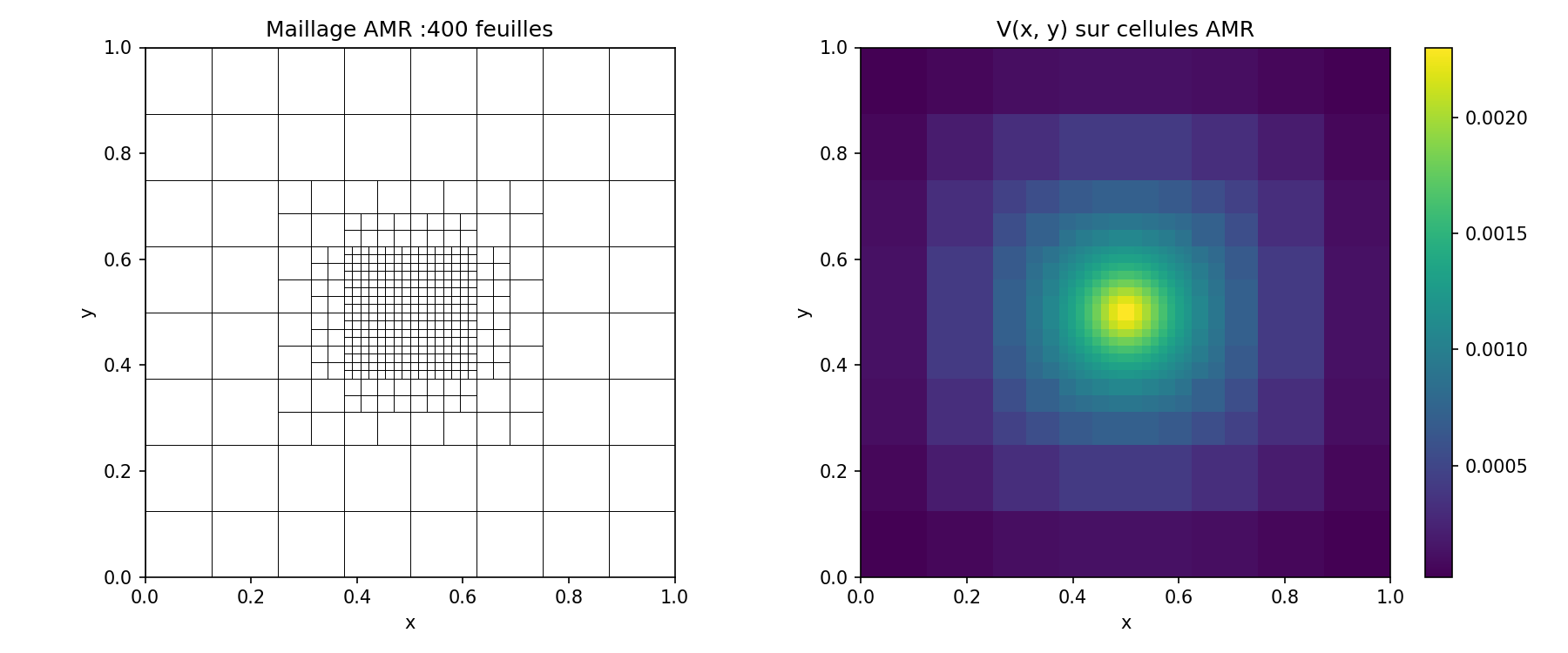 |
| CG : 187 iter / 8 ms vs SOR 1443 / 53 ms | AMR sur Gaussienne centrée, 400 feuilles, ×10 vs uniform |
Performance
Détails dans `docs/PERFORMANCE.md`. A/B mesurés avec sample / xctrace :
mg::gs_smoothN=128 : in-place red-black, −68 %.Solver2D::solveN=128 : in-place red-black +Vc_inv_précomputé, −46 %.amr::sor: précalculrhs = h²ρ/ε₀etVc_inv, −16 %.Solver2D::solve: fold Dirichlet → rhs pour débloquer SIMD, −5 %.- CG
apply_neg_laplacianN=512 :diag_matprécomputé hors hot loop, −18 %. - OpenMP (opt-in, N ≥ 384) : Solver2D + gs_smooth, ×1.5 à ×1.9.
Tests
66 tests Catch2 côté C++ + 50 tests pytest côté bindings Python. Couvrent :
- Invariants mathématiques (réciprocité de Green, linéarité, symétrie de réflexion) à 1e-13.
- Lois de conservation (Gauss, énergie, continuité D aux interfaces diélectriques) à 1e-12.
- 4 snapshots JSON vs les notebooks Python à 1e-10.
- Convergence O(h²) sur un benchmark Fourier (Jackson ch.2).
- Scaling CG en O(N), cross-check vs DST.
- Côté Python : workflow AMR + multigrille bout-en-bout, dataclasses, helpers (Morton, harmonic_mean, dump_amr_snapshot).
Détails : `docs/RESULTS.md` (figures de validation), `docs/PERFORMANCE.md` (benchmarks A/B + profiling).
License
BSD-3-Clause. Voir [LICENSE](LICENSE).