adc_cpp
|
adc_cpp 0.3.0
Model-free C++23 core for coupled hyperbolic-elliptic systems on adaptive (AMR) meshes, with MPI and GPU (Kokkos) backends
|
PoPS - Plasma-Oriented PDE Solver





PoPS is a model-free engine with a library of generic physics bricks (include/pops/physics/) and Python bindings (pops). It names no scenario; it provides generic bricks composed into a CompositeModel. Named scenarios (diocotron, Euler-Poisson, two-fluid) live in adc_cases.
On a Cartesian adaptive mesh, the core advances a hyperbolic part U coupled to an elliptic part phi:
The coupling flows through the aux channel at each step. The base contract is (phi, grad_x, grad_y); a model may declare n_aux to read extra fields (B_z, T_e).
Table of contents
- Prerequisites
- Installation
- Usage
- Documentation
- Versioning
- Contributing
- License
Prerequisites
- C++20 compiler: AppleClang 16+, GCC 13+, Clang 17+ (
nvcc_wrapperfor the CUDA target). - CMake >= 3.21: the build is driven by presets (CMakePresets.json).
- Kokkos 4.2+: the only on-node backend, required. No need to pre-install it; if it is not found, CMake fetches and builds it (FetchContent).
- MPI *(optional,
-DPOPS_USE_MPI=ON: halos and distributed FFT)*. - HDF5 parallel *(optional,
-DPOPS_USE_HDF5=ON: DataWriter)*. - Python 3.12 + numpy *(optional, the
popsbindings; conda env viascripts/setup_env.sh)*.
Per-platform backend coverage and known pitfalls (macOS, CUDA, conda, CI runners): docs/BACKEND_COVERAGE.md.
Installation
Three ways. Build-from-source details live in the installation guide rather than inline here.
C++ core, via CMake presets:
The Ninja build already uses every core; pin it to fewer jobs on a constrained machine with cmake --build --preset serial -j<N>. The serial test preset runs tests one at a time; parallelize with ctest --preset serial -j<N> (-j$(nproc) on Linux, -j$(sysctl -n hw.ncpu) on macOS), and add --output-on-failure for logs. Two other presets build a parallel backend instead of the serial one (both read $CONDA_PREFIX, so the conda env must be active):
Each preset writes into its own folder (build, build-kokkos, build-mpi). Backends and runtime thread control (pops.set_threads()) are covered in the installation guide.
Python module (pops): scripts/setup_env.sh creates the conda env and pins the platform toolchain, then scripts/build_python.sh builds and installs the module in one command (it sizes the heavy-TU pool, exports the discovery vars, and ends on pops.doctor()); pip install . (scikit-build-core) drives the build directly if you prefer. Backends are selected by environment variables (POPS_USE_MPI, Kokkos_ROOT, ...). scripts/uninstall_pops.sh reverses the two setup scripts when you want a clean teardown.
Released versions and binaries: the Releases page.
Usage
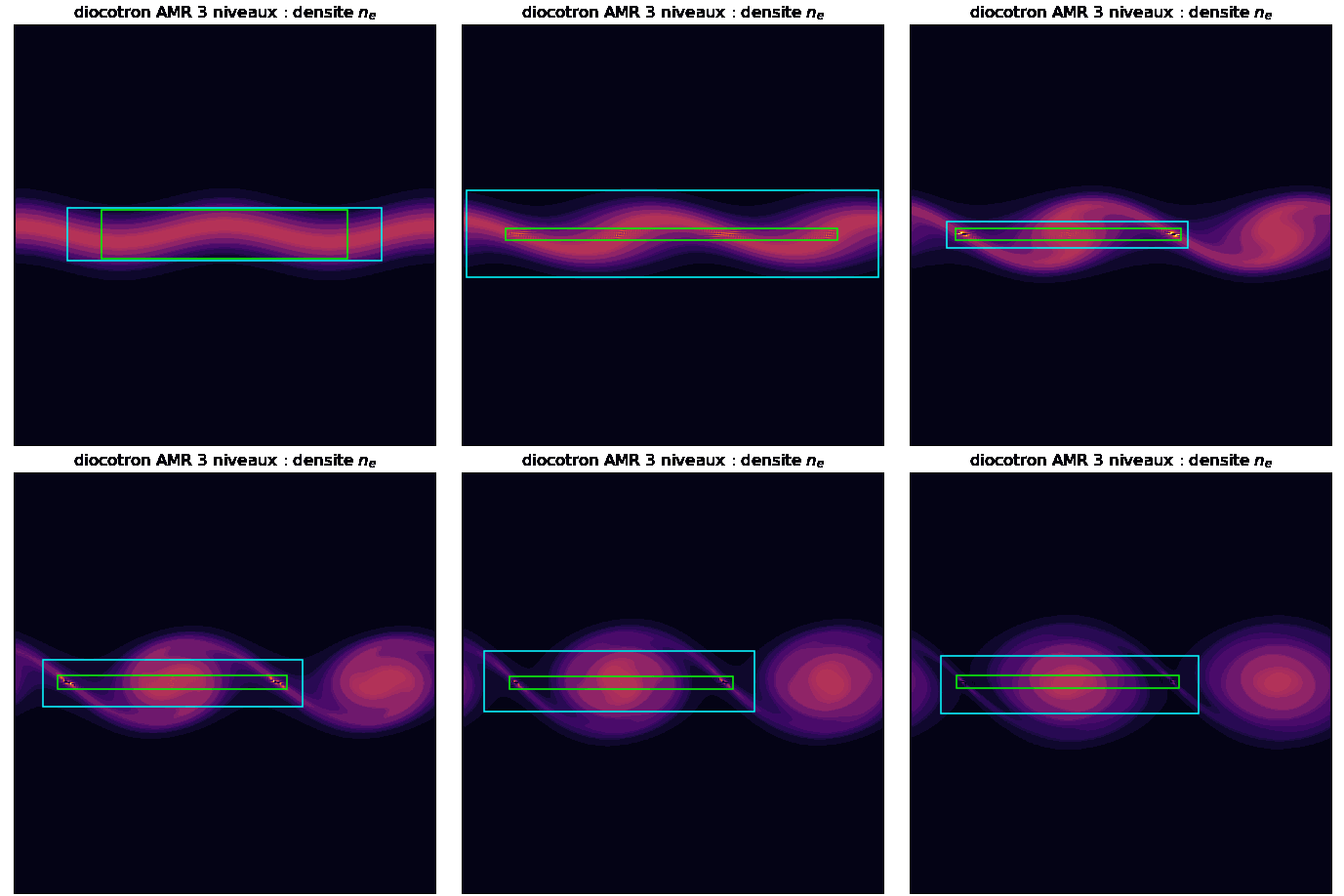
adc_cases/diocotron_amr. From a C++ project
The core is header-only and consumed via find_package(pops) or FetchContent:
Define a type that satisfies the PhysicalModel concept, wrap it in a Coupler<Model, Elliptic> (or AmrCouplerMP for AMR), and advance in time.
From Python
The public path is typed and compiled. Python builds an inert pops.Case; C++/Kokkos/MPI executes the run. User choices are descriptors, not string selectors. The reduced diocotron example below couples a scalar density to a Poisson field:
For an adaptive run, swap the layout to pops.mesh.layouts.AMR(mesh, max_levels=2, ratio=2) and author the refinement with typed pops.mesh.amr policies. pops.bind builds the AMR runtime from that layout. Users do not pass a public target string and do not instantiate the AMR runtime as the front door. Step-by-step tutorial: getting-started/tutorial. Reference: native-bricks, symbolic-dsl, public API contract.
Documentation
- User guide (Sphinx): https://wolf75222.github.io/adc_cpp/
- C++ reference (Doxygen): https://wolf75222.github.io/adc_cpp/cpp/
- Canonical guides: ARCHITECTURE (layers, modules, AMR), ALGORITHMS (methods, formulas), CHOICES (design), BACKEND_COVERAGE (backend / test matrix), VALIDATION.
- Documentation policy (taxonomy, tooling, update guide): DOC_QUALITY.
Core layers
| Layer | Role | Entry point |
|---|---|---|
core/ | types, state, PhysicalModel, EquationBlock, CoupledSystem | physical_model.hpp |
physics/ | generic bricks composed into a CompositeModel | composite.hpp |
numerics/ | reconstruction (Minmod / VanLeer / WENO5), flux (Rusanov / HLL / HLLC / Roe) | reconstruction.hpp |
numerics/elliptic/ | EllipticSolver concept, geometric multigrid, FFT, composite FAC | elliptic_solver.hpp |
numerics/time/ | SSP-RK, multirate scheduler, IMEX, splitting, AMR engine | numerics/time/ |
coupling/ | Coupler, SystemCoupler, AmrSystemCoupler, AmrCouplerMP | coupler.hpp |
amr/, mesh/, parallel/ | Berger-Rigoutsos clustering, regrid, MultiFab, MPI comm seam | amr/ |
runtime/ | System / AmrSystem facades, model_factory, DSL, aux channel | system.hpp |
Ecosystem
| Repo | Role |
|---|---|
adc_cpp (this repo) | hyperbolic-elliptic core on AMR, with GPU / MPI / Kokkos |
adc_cases | applications: named models, facades, examples, Python |
poisson_cpp | Poisson solvers (Thomas, SOR, CG, DST, multigrid) |
advection_cpp | advection, Burgers, Chorin Navier-Stokes |
euler_cpp | 2D Euler, viscous Navier-Stokes, plasma sources |
Versioning
PoPS follows Semantic Versioning. The public API under guarantee and the bump rules are declared in docs/VERSIONING.md. Available versions and their change logs: the Releases page and CHANGELOG.md. The project is in 0.y.z initial development: the public API may still change until 1.0.0.
Contributing
Build, test and workflow conventions: CONTRIBUTING.md.
License
BSD-3-Clause. See [LICENSE](LICENSE).
Generated by
 1.9.8
1.9.8